Unconstitutional Change After Constitutional Breakdown: Coups and the Crisis of Legitimacy in the African Union
/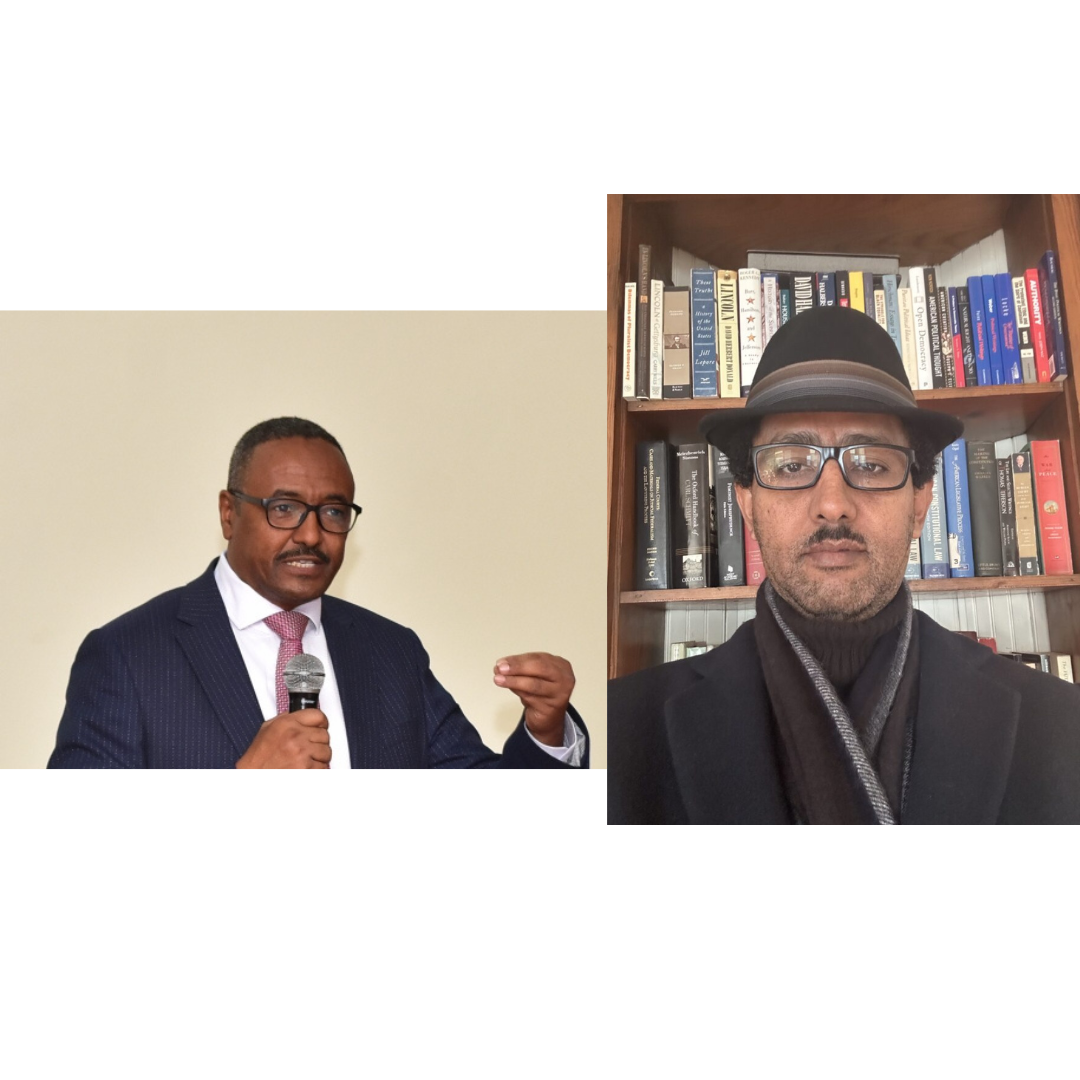
Sami Abdelhalim Saeed & Alemayehu Fentaw Weldemariam
Sami Abdelhalim Saeed, (LL.D) is the Vice President of the African Network of Constitutional Lawyers
Alemayehu Fentaw Weldemariam is a PhD Fellow at the Center for Constitutional Democracy, Indiana University Maurer School of Law
The resurgence of coups across Africa has placed renewed strain on one of the continent’s most ambitious normative projects: the African Union’s (AU’s) “zero tolerance” policy toward unconstitutional changes of government. Anchored in instruments such as the Lomé Declaration and the African Charter on Democracy, Elections and Governance, the framework purports to draw a clear line between constitutional order and its violation. Recent practice suggests that this line is far less stable than the doctrine assumes. Developments in Sudan, Guinea, Guinea-Bissau, Madagascar, and Mali expose a deeper instability at the heart of the AU anti-coup regime.
The AU’s anti-coup framework is constitutional in both form and ambition. Article 4 of the Constitutive Act of the African Union articulates a composite normative order: sovereignty and non-interference sit alongside commitments to democratic governance, human rights, and the categorical “condemnation and rejection of unconstitutional changes of governments.” Article 30 gives this principle institutional force by excluding regimes that come to power through unconstitutional means from participation in AU activities. These commitments are reinforced through institutions such as the African Commission on Human and Peoples’ Rights and the African Court on Human and Peoples’ Rights, extending the ambition to constitutionalize democratic legitimacy at the continental level.
On its own terms, the logic is straightforward: identify rupture, suspend recognition, and restore legality. Coups are treated as deviations from an otherwise valid constitutional baseline.
Sudan initially appears to fit this model. The military takeover of October 2021—dissolving the transitional government and suspending the constitutional framework—was plainly inconsistent with both domestic law and continental norms. The AU responded by suspending Sudan from participation in its activities. In formal terms, the rule was applied. Yet as the crisis deepened into protracted conflict, suspension reduced the AU’s ability to engage directly with the actors necessary for any political settlement. The response was a shift toward indirect engagement—coordination through multilateral platforms, technical participation, and incremental normalization without formal recognition. The AU thus operates in two registers at once: enforcing non-recognition while engaging with those it refuses to recognize.
This difficulty is often described as a tension between constitutionalism and pragmatism. That description is too shallow. The problem is not that the AU compromises its principles under pressure. It is that those principles presuppose a form of constitutional order that is frequently absent.
That absence is not only institutional but ideological. As Samuel Fury Childs Daly shows, military intervention in postcolonial Africa has long been justified as a competing claim to legitimacy. Where civilian regimes appear ineffective, corrupt, or incapable of delivering basic goods, militarism offers an alternative grammar of authority grounded in discipline and order. As Daly observes, “promises of liberty were replaced by a vision of discipline,” as military principles displaced the language of civilian politics. Militarism thus operates not only as coercion, but as a rival theory of political order.
Once this is recognized, the AU’s central distinction begins to unravel. If constitutional rule is widely perceived as hollow or manipulated, coups cannot be understood simply as external violations of a settled order. They emerge from within the same crisis of legitimacy that constitutional frameworks fail to resolve.
Guinea illustrates this dynamic with particular clarity. The 2021 coup led by Mamady Doumbouya followed a prolonged erosion of constitutional credibility under President Alpha Condé, whose 2020 constitutional referendum reset term limits and triggered widespread unrest. The military’s intervention was therefore not uniformly experienced as rupture, but as correction. The subsequent transition deepens the contradiction. Following a constitutional referendum in September 2025 and presidential elections in December 2025, Doumbouya—himself the coup leader—was elected president and sworn in on 17 January 2026. In its communiqué of 22 January 2026, the African Union Peace and Security Council welcomed the transition, congratulated Doumbouya, and lifted Guinea’s suspension. The election was framed as restoring constitutional order. Yet this recognition sits uneasily with Article 25(4) of the African Charter on Democracy, Elections and Governance, which bars coup leaders from participating in such elections. What begins as categorical rejection culminates in recognition: those who suspend constitutional order are subsequently treated as its restorers.
The contrast with Guinea-Bissau shows that this is not a gradual evolution but a structural inconsistency. Following the November 2025 coup, the African Union Peace and Security Council applied its doctrine in classical form: it condemned the seizure of power, reaffirmed its “zero tolerance” policy, and immediately suspended the country pending restoration of constitutional order. The intervention—occurring amid contested electoral results—was treated as a paradigmatic violation. Yet the same framework, applied to Guinea, yields the opposite outcome: reintegration and recognition of a process led by the perpetrators of the coup. In one case, military intervention triggers exclusion; in another, it becomes the pathway to recognition. The divergence is not explained by differences in principle, but by the absence of a stable standard for what counts as restoration.
Madagascar exposes a deeper instability. In October 2025, following weeks of youth-led protests over economic hardship and governance failures, the elite CAPSAT military unit aligned with demonstrators, prompting President Andry Rajoelina to flee. The High Constitutional Court declared the presidency vacant and transferred authority to Colonel Michael Randrianirina, who was sworn in through formal judicial process. This constitutional framing coexisted with popular endorsement, as protesters welcomed the military’s intervention. Yet at the same time, the African Union Peace and Security Council condemned the episode as an unconstitutional change of government and imposed suspension, while the Southern African Development Community declined to do so. The same event was thus simultaneously constitutionalized, popularized, and condemned. The distinction between constitutional and unconstitutional change fractures at the level of classification itself.
Mali reinforces this pattern in a stark form. Following the August 2020 overthrow of President Ibrahim Boubacar Keïta, a civilian-led transitional government was established under military supervision. Yet in May 2021, Vice President Assimi Goïta—himself the architect of the earlier coup—arrested the interim president and prime minister, citing alleged violations of the transitional charter. The justification was framed in legal terms, even as it amounted to a second coup within nine months. Once military actors are embedded within transitional arrangements, the distinction between constitutional governance and military oversight collapses. What is presented as the defense of the transition becomes the mechanism of its suspension. The recurrence of coups in Mali is thus not episodic but structural.
This pattern is not confined to individual cases. The Africa Governance Report 2023 identifies unconstitutional changes of government as the culmination of deeper failures: governance deficits, constitutional manipulation, contested elections, and declining public trust. Similarly, Solomon Ayele Dersso emphasizes that such changes arise from systemic deficiencies in democratic governance rather than isolated acts of military opportunism. The AU has attempted to adapt by expanding its definition of unconstitutional change to include constitutional manipulation. But this expansion produces a contradiction: once formally legal mechanisms can themselves undermine constitutionalism, the boundary between constitutional and unconstitutional change becomes unstable.
The consequences are evident in practice. Enforcement is uneven, reactive, and dependent on context. The AU lacks clear criteria for determining when constitutional order has been restored and has limited tools for addressing the governance deficits that precede coups. The result is a regime that punishes rupture while leaving its underlying causes intact.
Under these conditions, the AU’s anti-coup regime no longer functions as a rule governing unconstitutional change. It operates instead as a context-dependent mechanism for reallocating legitimacy after its breakdown. In Sudan, enforcement gives way to engagement; in Guinea, illegality is converted into recognized authority; in Guinea-Bissau, the rule is applied in its classical form; in Madagascar, classification itself becomes contested; and in Mali, constitutional breakdown reproduces itself within transition. These cases do not reflect variation around a stable norm. They reveal the absence of a shared account of what constitutes constitutional order in the first place.
The challenge, therefore, is not simply to abandon the AU’s distinction between constitutional and unconstitutional change, nor to deny the value of doctrinal refinement. A more precise doctrine is necessary: the AU needs clearer criteria for determining when constitutional order has been restored, whether coup leaders may participate in transitional politics, how manipulated constitutional amendments should be treated, and what forms of civilian participation can legitimate a transition. But refinement will remain inadequate if it merely adds exceptions to the existing dichotomy. The deeper task is to move beyond a binary model of rupture and restoration toward a legitimacy-sensitive framework that evaluates transitions according to process, inclusion, civilian control, constitutional good faith, and credible guarantees against military entrenchment. The AU’s anti-coup regime should therefore be reoriented from a rule that simply condemns unconstitutional seizure of power to a framework that also addresses the conditions under which constitutional authority can be rebuilt after breakdown.
Sami Abdelhalim Saeed, (LL.D) is the Vice President of the African Network of Constitutional Lawyers
Alemayehu Fentaw Weldemariam is a PhD Fellow at the Center for Constitutional Democracy, Indiana University Maurer School of Law
Suggested citation: Sami Abdelhalim Saeed and Alemayehu Fentaw Weldemariam, Unconstitutional Change After Constitutional Breakdown: Coups and the Crisis of Legitimacy in the African Union’ IACL-AIDC Blog (23/06/2026) Unconstitutional Change After Constitutional Breakdown: Coups and the Crisis of Legitimacy in the African Union — IACL-IADC Blog


![Xx1088_-_Seoul_city_nightscape_during_1988_Paralympics_-_3b_-_Scan [test].jpg](https://images.squarespace-cdn.com/content/v1/5af3f84a4eddec846552ea29/1527486925632-3VZP3ASLAHP1LJI0D9NJ/Xx1088_-_Seoul_city_nightscape_during_1988_Paralympics_-_3b_-_Scan+%5Btest%5D.jpg)
