
Judicial Bricolage The Use of Foreign Precedents by Constitutional Judges in the 21st Century
/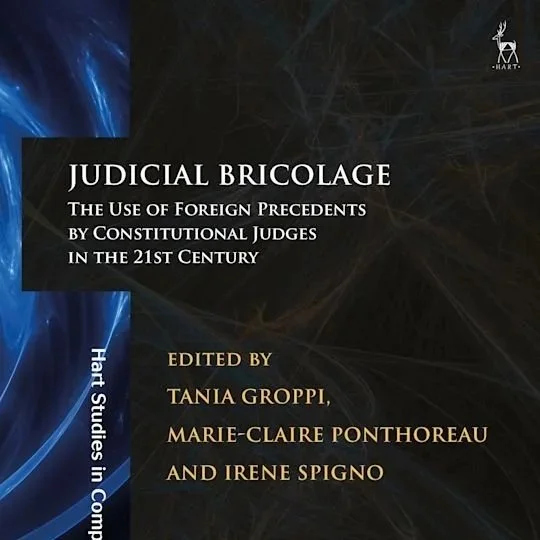
Tania Groppi, Marie-Claire Ponthoreau, Irene Spigno (eds)
Tania Groppi, Professor of Public Law, University of Siena (Italy), Executive Committee Member of the IACL
Marie-Claire Ponthoreau, Professor of Constitutional Law, University of Bordeaux (France)
Irene Spigno, Professor of Comparative Constitutional Law, Interamerican Academy of Human Rights, Autonomous University of Coahuila (Mexico)
The book revisits and expands your earlier work from 2013. What motivated you to return to this topic ten years later?
Marie-Claire Ponthoreau (MCP): First and foremost, there is a human story. We succeeded in forming a research group within the framework of an initiative of the International Association of Constitutional Law, which in 2008, for the first time, encouraged the creation of interest groups around a specific research theme. Tania Groppi and I shared a common interest. I had just published an article on the citation of foreign precedents by constitutional judges, based on a limited number of decisions and the existing scholarship on the subject (“Le recours à ‘l’argument de droit comparé’ par le juge constitutionnel. Quelques problèmes théoriques et techniques”, in F. Mélin Soucramanien (ed.), L’interprétation constitutionnelle, Actes de la Table Ronde de l’AIDC, Dalloz, 2005, pp.167-184). We agreed on the need to empirically test the reality of such citations, as it was already clear that the existing scholarship tended to say more than actual practice revealed. Such verification could only be achieved through collective research.
This work also emerged at a time marked by the expansion of constitutionalism. It was often framed in terms of “global constitutionalism,” driven by a transnational judicial conversation. More than a decade later, it became important to reassess whether such a discourse could still be sustained (as we had already expressed doubts about this idea), at a time when this expansion had stalled, and the focus had shifted toward what is now described as “democratic backsliding.”
Comparative constitutional law also greatly benefited from this context of expansion and came to be seen as a leading discipline with broad international reach. The field also moved beyond its traditional historical examples to engage with a wider range of constitutional experiences. This was therefore the right moment to reconvene the group and broaden its composition to include less-studied courts. The result is not entirely satisfactory: while we have better incorporated Latin America, the same cannot be said of Africa.
The notion of “judicial bricolage” is central to your analysis. Could you elaborate on this concept?
MCP: The notion of “judicial bricolage” plays a central role in situating our collective research and the volume, which emphasizes the pragmatism of constitutional judges in citing foreign precedents in their decisions. However, we did not explicitly highlight our main source of inspiration: Claude Lévi-Strauss. He introduced a crucial distinction between the bricoleur and the engineer in La Pensée sauvage (1962). The bricoleur is one who makes use of available materials and reassembles heterogeneous elements. More importantly, he draws on pre-existing structures of thought. This resonates closely with judicial practice, as judges sometimes rely on reasoning developed by other courts faced with similar legal issues—even if, in most cases, this serves merely as a source of inspiration rather than a direct replication of another court’s reasoning.
The success of Lévi-Strauss’s idea—never formulated as a methodological prescription—lies in the flexibility it affords, which has resonated strongly across the social sciences. To such an extent that the idea of “bricolage” has become a recognized research principle. For this reason, we did not dwell on it, assuming that the notion, now widely established, adequately captures the pragmatic use of foreign precedents by judges.
The book combines quantitative and qualitative methodologies. What were the main methodological challenges of conducting such a large-scale empirical project?
Irene Spigno (IS): I believe one of the book’s main methodological challenges was constructing common comparative criteria applicable to a wide variety of legal systems. Given that the volume encompasses 31 countries across five continents and 35 authors, it was necessary to develop shared criteria and a common analytical language—solid yet flexible—that would allow for the consistent identification and comparison of the use of foreign precedents.
A second significant challenge concerned the collection of relevant information and access to case law. In some legal systems, the rulings issued by constitutional judges are not excessive in number, are easily accessible, and well-organized. In others, however, they are fragmented, not fully digitized, or are difficult to find. This required a significant effort to identify and select the relevant decisions.
Another critical element was linguistic diversity. Although the book was published in English, the project involved a wide variety of legal languages, posing not only translation challenges but also conceptual equivalence challenges. Seemingly similar notions—such as “foreign precedent” or “citation”—can take on different meanings in different contexts, requiring constant work to refine methodological alignment.
Finally, managing a large and diverse group of authors posed an additional challenge: ensuring coherence, uniformity, and methodological rigour across the different chapters required intense editorial coordination.
How do you see the relationship between the use of foreign precedents and current trends such as democratic erosion or illiberal constitutionalism, particularly in light of the resistance—or even backlash—highlighted in some chapters? How can this phenomenon be explained?
IS: I believe the relationship between the use of foreign precedents and current trends of democratic erosion or illiberal constitutionalism is profoundly ambivalent. On the one hand, the use of comparative law has traditionally been associated with openness, dialogue, and the strengthening of constitutional reasoning. On the other hand, in the context of current democratic backsliding, we can observe both a form of resistance to foreign references and—paradoxically—a selective and strategic use of them.
In some legal systems, as emerges in several chapters of the volume, democratic backsliding is explained by the growing appeal to concepts such as constitutional identity, sovereignty, and majoritarian legitimacy. In this context, foreign influences on law are generally delegitimized as they are perceived as interference, distant from the internal democratic will.
Nonetheless, foreign precedents do not disappear from constitutional judicial reasoning. They may be reinterpreted, selected, or exploited to support positions already adopted at the national level. This might suggest that judicial bricolage continues to survive even in illiberal contexts, but probably in a more fragmented and less dialogic form.
Your book received the 2025 Book of the Year Prize from the International Forum on the Future of Constitutionalism. What do you think explains the resonance of this work in today’s scholarly and judicial debates?
MCP: We are delighted to have received this award, especially on behalf of the junior scholars in the group. It gives them greater visibility within a discipline that has become increasingly developed. From a scholarly perspective, this success can be explained by a question that has mobilized the field to a significant extent. It may be argued that this question has been at the heart of the discipline’s transformations, particularly in its international dimension. To better understand these developments, it is useful to recall the position of Bruce Ackerman. While he remained, until the late 1990s, within a traditional approach to American law—largely inward-looking—he later advocated a different perspective, one that seeks to understand the national experience “as a special case, rather than as a paradigmatic one” (“The Rise of World Constitutionalism” 83, Virginia Law Review, 1997, p. 774-75). At the same time, a debate emerged within the Supreme Court of the United States concerning the use of foreign judicial precedents in constitutional interpretation. The well-known case of Printz v. United States is emblematic in this regard, as Justices Stephen Breyer and Antonin Scalia articulated opposing views on this method. Since then, the controversy—still very much alive—has played a significant role in the development of comparative constitutional law in the United States and well beyond.
Finally, what’s next for your research on comparative constitutional law?
MCP: I am not currently involved in a collective project, although I am convinced that comparative research has now become difficult to pursue without a team. Perhaps this is one of the privileges that comes with experience: I feel the need to return to more individual work—provided, of course, that academic life leaves enough time for writing, something that is becoming increasingly rare within the French university system.
IS: The International Association of Constitutional Law’s Interest Group on “Cross-Judicial Fertilization” will continue to focus on the topic of judicial dialogue, but will broaden its perspective to include more complex and contemporary forms of constitutional communication, which go beyond the traditional analysis of the use of foreign precedents. In this regard, we have organized a workshop as part of the IACL World Congress to be held in Bogotá in July 2026, on “Constitutional Dialogues: Judicial and Extrajudicial Dimensions of Constitutional Courts’ Communication.”
The guiding question for this new phase of research is: how do constitutional courts communicate in the 21st century, and to whom do they address themselves? This entails considering constitutional dialogue not only as a practice between courts, but as a multilevel phenomenon, developing across three different dimensions. First, the institutional dimension, which concerns forms of para-judicial and extra-judicial communication (press releases, conferences, official statements, but also judicial diplomacy activities, networks between courts, and relations with academia). Second, the judicial dimension, which focuses on the reasoning behind decisions and the degree of openness of constitutional argumentation, including references to international and comparative law, the use of non-strictly legal arguments, as well as the contribution of experts or amicus curiae. Finally, the public dimension, which concerns the relationship between courts and society, particularly through the use of social media and the role of courts in promoting greater constitutional literacy.
In this sense, the future of research lies not only in understanding whether a dialogue between courts exists, but in understanding how this dialogue is transforming, expanding, and interacting with new actors and new spaces of communication in contemporary comparative constitutionalism.
Find the book: https://www.bloomsbury.com/us/judicial-bricolage-9781509974009/
To receive 20% discount, use code GLR BD8 at the checkout.
Tania Groppi, Professor of Public Law, University of Siena (Italy), Executive Committee Member of the IACL
Marie-Claire Ponthoreau, Professor of Constitutional Law, University of Bordeaux (France)
Irene Spigno, Professor of Comparative Constitutional Law, Interamerican Academy of Human Rights, Autonomous University of Coahuila (Mexico)
Suggested Citation: Tania Groppi, Marie-Claire Ponthoreau & Irene Spigno, ‘Judicial Bricolage. The Use of Foreign Precedents by Constitutional Judges in the 21st Century’ IACL-AIDC Blog (26/05/2026) Judicial Bricolage The Use of Foreign Precedents by Constitutional Judges in the 21st Century — IACL-IADC Blog