
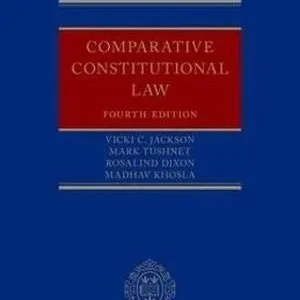
Comparative Constitutional Law: Fourth Edition
/
Vicki C Jackson, Laurence H Tribe Professor of Constitutional Law, Harvard Law School
Mark Tushnet, William Nelson Cromwell Professor of Law Emeritus, Harvard Law School
Rosalind Dixon, Professor, University of New South Wales, Faculty of Law & Justice
Madhav Khosla, Associate Professor of Law, Columbia Law School
Designed for use in law school courses, Comparative Constitutional Law introduces fundamental debates on the nature of constitutions, constitutional comparison, and the relationships between constitutions and constitutionalism in its various forms. Providing an overview of constitutional law that is both comprehensive and accessible, the fourth edition of Comparative Constitutional Law is an invaluable resource for law students and academics.
What does this casebook cover?
Mark Tushnet: The casebook offers a reasonably comprehensive overview of the content of constitutions around the world, including issues of constitutional structure on the national level and vertically through federalism, equality rights, rights of expression and religion, and so-called second- and third-generation rights. It also provides an introduction to ideas about constitutionalism itself, about the connection between entrenchment and constitutionalism, and about the role or roles courts play in constitutional interpretation.
Madhav Khosla: The casebook offers a comparative study of constitutions and constitutional systems across a diverse range of countries. The study involves themes that have shaped our understanding of modern constitutionalism, from the separation of powers to rights, and explores the similarities and differences in how they have been realized in practice.
Tell us more about the new edition of the casebook. What are the most important additions or changes made?
Mark Tushnet: In addition to general updates, this edition includes more material from the Global South, including a substantial revision of material on affirmative action/reservations in India.
Madhav Khosla: The new edition arrives at a time when constitutionalism itself is facing new threats and fresh challenges, and when non-democratic nations are, in their own ways, embracing legality. The Casebook is sensitive to such developments, thereby expanding the countries under study and the questions under consideration.
Mark Tushnet: In addition, the material on emergency powers supplements the prior treatment of national security emergencies with the role emergency powers played during the COVID-19 pandemic. The treatment of gender equality and other bases for equality claims in national constitutions has been significantly expanded. Other material has been tightened to allow for this additional material.
Rosalind Dixon: Cutting in this way was definitely a challenge, but as Mark says–it was necessary to make room for new material. Including more on gender was an especially welcome opportunity for Vicki and myself, given our longstanding research and teaching interests in this area.
The new edition brings on board 2 new editors. Tell us about what they added to the team.
Mark Tushnet: From my perspective as one of the original editors, our new colleagues provided guidance about issues that had become important since we originally structured the casebook and about the inclusion of material from the Global South.
Vicki C Jackson: Having two such exceptional scholars as Ros Dixon and Madhav Khosla join the casebook increases the sociolegal perspectives that inform its coverage, coming as they do with deep knowledge of legal systems different from those of the two original editors.
How do you envisage teachers using it in large and smaller CCL electives?
Mark Tushnet: Because of the casebook’s comprehensiveness, it is quite long, and teachers using it will inevitably make decisions about what to include in a standard-length course. For what it’s worth, next semester I’m teaching a course in which I’m asking students to read quite a substantial amount of material each week (and have offered guidelines about how they might use AI techniques in doing so, though I advise them to do so within strict limits). I’m hoping to cover most of the book’s chapters, though—probably unusually for instructors—I’m not planning to have students examine the various ways in which constitutional courts are structured, including methods of selection and tenure, as well as procedures used in such courts.
Madhav Khosla: The size of the Casebook should, counterintuitively, aid its usage across different possible class and teaching permutations, for the text lends itself rather well to being excerpted and selectively used. The range of countries, subjects, materials, questions, and so on means that teachers will be able to use the Casebook to create very different kinds of classes.
What are the challenges for students and teachers in using a book of this kind? What does this say about the future of the field?
Mark Tushnet: The core challenge remains what it has always been—to develop ways of instruction that allow students to learn how to tack back and forth between the ways of thinking they are familiar with from their own legal systems, and the ways of thinking used in unfamiliar legal systems. Becoming legally “multilingual” is quite difficult, and this casebook—unlike some others—introduces “multilinguality” by drawing from quite a few jurisdictions, in contrast to other coursebooks that focus on no more than two or three jurisdictions (which I regard as a sensible pedagogic choice, though not one we made for our book).
Madhav Khosla: I think the big challenge lies in understanding - and in helping students understand–what one does with the relevant material. Sure, we bring to light a range of comparative knowledge, but how does one use that knowledge? What is its relationship to legal theory and to legal practice? How does the answer to this change across time and space?
When everything is online, why should we keep producing and teaching from casebooks of this kind?
Mark Tushnet: Producing this sort of work is a valuable way for scholars to work out for themselves what they think are the major issues in the field and, almost as importantly, what materials are most useful in illuminating those issues. Teaching from them allows teachers interested in the field but not interested in devoting the time to developing their own materials—which is as noted interesting to some degree but also involves a fair amount of drudgery—to give students an overview of the field, while also allowing the instructors to developing their own scholarship in specific areas.
Vicki C Jackson: Given the welter of available materials, casebooks remain a useful tool to help scholars and teachers think about organizing material, whether in relying on the selections provided or reacting to them to include other material
What do you predict will be different in the field of comparative constitutional studies (‘CCS’) when the next edition is published?
Mark Tushnet: Pedagogically, I expect that instructors will have figured out how to develop materials that allow for the productive use of AI techniques while still ensuring that students assimilate comparative ways of thinking into their repertoire of modes of legal discourse. Substantively, I expect that there will be substantial developments in the law dealing with the relation between AI and expression (and perhaps religion), and in the conceptualization and implementation of third-generation rights.
Rosalind Dixon: I could not agree more. I think teaching CCS will also involve deploying AI to provide ready answers, make teaching more critical and interactive, and allow us to access materials in currently hard to access languages. In addition, the field as a whole will almost certainly be grappling with what our late and dear friend, Ran Hirschl, has recently labelled “planetary” level challenges – such as climate change, global migration and inequality, including but not exclusively through the prism of third-generation rights.
Vicki C Jackson is Laurence H Tribe Professor of Constitutional Law, Harvard Law School
Mark Tushnet is William Nelson Cromwell Professor of Law Emeritus, Harvard Law School
Rosalind Dixon is Professor, University of New South Wales, Faculty of Law & Justice
Madhav Khosla is Associate Professor of Law, Columbia Law School
Suggested Citation: Vicki C Jackson, Mark Tushnet, Rosalind Dixon & Madhav Khosla, ‘Comparative Constitutional Law: Fourth Edition’ IACL-AIDC Blog (16 June 2026) https://blog-iacl-aidc.org/just-published/2026/6/16/comparative-constitutional-law-fourth-edition