

The Eurosceptic Mobilization of Constitutional Law
/
Pablo Castillo-Ortiz and Giuseppe Martinico
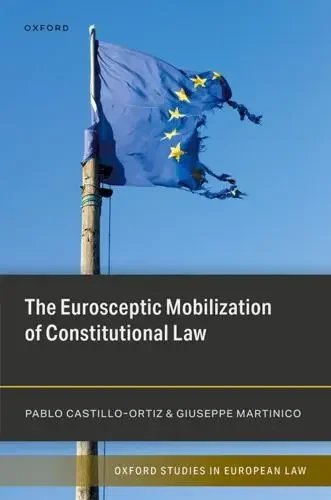
Pablo Castillo-Ortiz and Giuseppe Martinico discuss their new book The Eurosceptic Mobilization of Constitutional Law (Oxford University Press 2026), which examines how Eurosceptic political actors mobilise national constitutional law against European integration.
The Eurosceptic Mobilization of Constitutional Law
Pablo Castillo-Ortiz and Giuseppe Martinico
Pablo Castillo-Ortiz and Giuseppe Martinico discuss their new book The Eurosceptic Mobilization of Constitutional Law (Oxford University Press 2026), which examines how Eurosceptic political actors mobilise national constitutional law against European integration.
Tell us a little bit about the book.
The Eurosceptic Mobilization of Constitutional Law examines how Eurosceptic political actors use the language, concepts and institutions of national constitutional law against European integration. Euroscepticism is generally studied through public opinion, electoral behaviour and party politics. Our book approaches it instead as a constitutional phenomenon.
We analyse how concepts such as sovereignty, democracy, constitutional identity and constitutional supremacy are selectively mobilised to portray the European Union as an external constraint and to present national constitutions as fundamentally incompatible with EU law. We describe these arguments as “constitutional counter-narratives”: strategic and often highly selective interpretations of constitutional law that allow Eurosceptic actors to present themselves as defenders of national democracy rather than simply as opponents of European integration.
The book combines a theoretical discussion of post-war constitutionalism and constitutional openness with case studies of the United Kingdom, Italy, Spain and Poland. These countries represent different constitutional traditions, geographical areas and experiences of European integration.
Our central argument is that Euroscepticism does not operate only through demands to leave the European Union. It can also seek to weaken integration from within by challenging the primacy of EU law, attacking supranational courts and mobilising national constitutional institutions against European obligations. In this sense, Eurosceptic actors attempt to transform the traditional idea of “integration through law” into a process of “disintegration through constitutional law”.
At the same time, the book does not treat every constitutional disagreement with the EU as illegitimate. Constitutional conflict has sometimes improved European law, particularly in the protection of fundamental rights. We therefore seek to distinguish productive constitutional criticism from the abusive and instrumental mobilisation of constitutional arguments.
What inspired you to take up this project?
The immediate idea for the book emerged during a conference on illiberal constitutional justice held in Aix-en-Provence in 2023. We had known each other for almost ten years, but the pandemic had interrupted our exchanges. At dinner, we began discussing our respective research interests and realised that they converged around a question that had received surprisingly little attention: how do Eurosceptic political actors use constitutional law against European integration?
The broader inspiration came from developments across Europe, where political actors increasingly framed resistance to European integration in constitutional terms, invoking sovereignty, democracy, national identity and constitutional supremacy. This suggested that Euroscepticism could be studied not only as an electoral strategy or public attitude, but also as a form of constitutional mobilisation. This seemed to us particularly important because constitutional law is generally presented as a neutral or technical field. In practice, however, its language and institutions can be mobilised strategically. The book therefore asks how constitutional arguments are converted into political weapons and used to give Eurosceptic agendas greater legitimacy and respectability. Our aim was not to write a self-defence manual for Europeanists, but to take these arguments seriously and assess whether they offer a convincing account of national and European constitutionalism.
Whose work was influential on you throughout the project?
The project lies at the intersection of political science, European law and comparative constitutional law, and our intellectual influences reflect that interdisciplinary character.
The political science literature on Euroscepticism provided an essential starting point. In particular, the distinction between “hard” and “soft” Euroscepticism developed by Paul Taggart and Aleks Szczerbiak helped us consider whether attacks on the fundamental principles of EU law can amount to hard Euroscepticism even when withdrawal is not formally proposed. Sofia Vasilopoulou’s work was also influential in encouraging the study of Euroscepticism beyond party politics and public opinion.
Our understanding of legal mobilisation was informed by scholars such as Clifford Bob and Paul Blokker, who have shown how rights, legal institutions and liberal constitutional tools may be used strategically, including for illiberal purposes. The works of Nadia Urbinati and Luigi Corrias on populism helped us conceptualise the parasitic appropriation of the language and institutions of constitutional democracy.
On the constitutional side, the works of Boris Mirkine-Guetzévitch, Eric Stein, Alejandro Saiz Arnaiz and Paolo Carrozza were important to our understanding of constitutional openness and the international orientation of post-war European constitutions. Alessandro Pizzorusso’s and Armin von Bogdandy’s scholarship —on European law as part of the European constitutional heritage and on the concept of structural compatibility, respectively— has helped us explain the relationship between the EU legal order and national constitutions.
What challenges did you face in writing the book?
The principal challenge was methodological. Eurosceptic constitutional mobilisation is not confined to one type of actor or source. It can appear in party manifestos, constitutional amendments, parliamentary proposals, judicial decisions, political speeches and academic writings. We therefore had to combine doctrinal legal analysis with attention to political strategies and narratives.
The comparative dimension created an additional difficulty. Our case studies —the United Kingdom, Italy, Spain and Poland— represent different constitutional traditions, different histories of European integration and different forms of Euroscepticism. We wanted to identify common patterns without erasing important national differences. Working across several languages and rapidly evolving political contexts also meant that the object of study frequently changed while we were writing.
The most difficult conceptual challenge was distinguishing legitimate constitutional criticism from abusive mobilisation. We do not believe that every challenge to EU law is inherently illegitimate. Constitutional conflicts have sometimes contributed positively to European integration, as happened when national constitutional courts pushed the European legal order to take fundamental rights more seriously. We therefore wanted to avoid treating every appeal to sovereignty, constitutional identity or national constitutional supremacy as Eurosceptic abuse.
The dividing line is necessarily contextual. We looked at whether political and judicial actors engage seriously with EU law, respect sincere cooperation and use constitutional arguments to improve the relationship between legal orders, or instead cherry-pick constitutional concepts to undermine their shared foundations.
There were also the ordinary challenges of writing a book collaboratively while balancing teaching, institutional responsibilities and family life. The support and patience of our families and colleagues were indispensable.
What do you hope to see as the book’s contribution to academic discourse and constitutional or public law more broadly?
We hope, first, that the book will help bring constitutional law into the study of Euroscepticism. The literature on Euroscepticism is extensive but has largely been dominated by political science. Legal scholarship has paid comparatively less attention to the strategic mobilisation of constitutional arguments, institutions and procedures by Eurosceptic actors.
Our principal claim is that hard Euroscepticism should not be identified exclusively with proposals to leave the European Union. Actors may reject the foundations of European integration while formally remaining within the Union. By challenging primacy, attacking supranational courts and presenting national constitutions and EU law as irreconcilable, they seek to transform “integration through law” into “disintegration through constitutional law”.
We also hope to contribute to broader debates about constitutionalism. The book argues that Eurosceptic counter-narratives often misunderstand the constitutions they claim to defend. Post-war European constitutions are not founded on an absolute and isolationist conception of sovereignty. They are characterised by openness to international cooperation, the protection of fundamental rights and the rejection of authoritarian nationalism.
At the same time, we do not argue that the EU is infallible or that constitutional resistance is always objectionable. Our aim is to provide tools for distinguishing productive constitutional conflict from the selective and instrumental use of constitutional law. More broadly, we hope the book shows why constitutional concepts should not be abandoned to actors who use them to undermine both European integration and domestic liberal constitutionalism.
What’s next?
The themes explored in this book will continue to inform our research, particularly the use and possible misuse of concepts such as constitutional identity, sovereignty and common values in the relationship between national and supranational legal orders. One next step is therefore to extend the analysis beyond the four principal case studies in the book. We are particularly interested in how constitutional identity, sovereignty and traditional values are being mobilised in other Member States and in the transnational circulation of these arguments.
A second direction concerns responses. The book primarily reconstructs and evaluates Eurosceptic strategies; it does not offer a comprehensive programme for responding to them. Future research should examine how constitutional theory, political parties and European institutions might reclaim concepts such as sovereignty and identity rather than leaving them under the control of Eurosceptic and illiberal actors. Identity need not operate as a wall separating political communities: it can also function as a bridge through which political and constitutional orders change by engaging with others.
Giuseppe is currently working on several related projects. Together with John Morijn, he is co-editing a handbook for Cambridge University Press on Article 2 TEU from both EU and comparative perspectives. The volume will examine how the values listed in Article 2 —including democracy, the rule of law, equality and respect for human rights— are understood differently across legal traditions at the supranational and domestic levels. This develops one of the present book’s central concerns: the relationship between the values shared by the EU and its Member States and the different constitutional contexts in which those values are interpreted.
Giuseppe is also co-editing, with Xueyan Wu, a volume on the legal dimensions of China’s Belt and Road Initiative, which will be published by Routledge next year. Although its geographical and institutional focus is different, this project similarly examines the interaction between domestic, transnational and international legal orders.
Pablo, meanwhile, is working on a new book about the assault on constitutionalism that appears to characterise the present historical moment. The project will examine the pressures currently facing constitutional democracy and the ways in which constitutional institutions, principles and language are being challenged or appropriated by political actors.
More broadly, our future research will continue to explore how constitutional ideas operate beyond the state and how concepts developed within liberal constitutionalism may be contested, transformed or strategically appropriated in different legal and political settings.
Pablo Castillo-Ortiz and Giuseppe Martinico, ‘The Eurosceptic Mobilization of Constitutional Law’, IACL-AIDC Blog (1 October 2026) The Eurosceptic Mobilization of Constitutional Law